Discover how science transforms date palm waste into a sustainable, biodegradable material that supports a cleaner future for the UAE.
Explore the scientific principles behind our innovation and discover how date palm waste is transformed into a sustainable, biodegradable material that helps reduce environmental impact

Life and Decomposition
Biodegradable plastic relies on natural biological processes to break down safely in the environment. Date palm waste contains cellulose, a natural organic compound found in plant cell walls, which can be used to produce bioplastic.
Biodegradation occurs through the action of microorganisms such as bacteria and fungi. These organisms release enzymes that break down the material into simpler substances such as water, carbon dioxide, and organic matter. Unlike traditional plastics, which can persist in the environment for hundreds of years, biodegradable plastic decomposes naturally without causing long-term environmental harm.
The rate of decomposition depends on biological and environmental factors, including temperature, moisture, oxygen availability, and microbial activity. In the UAE’s hot climate, higher temperatures can increase microbial activity, which may accelerate the breakdown process.
Overall, this biological process ensures that the material safely returns to the environment, making it a sustainable and eco-friendly alternative to conventional plastic.
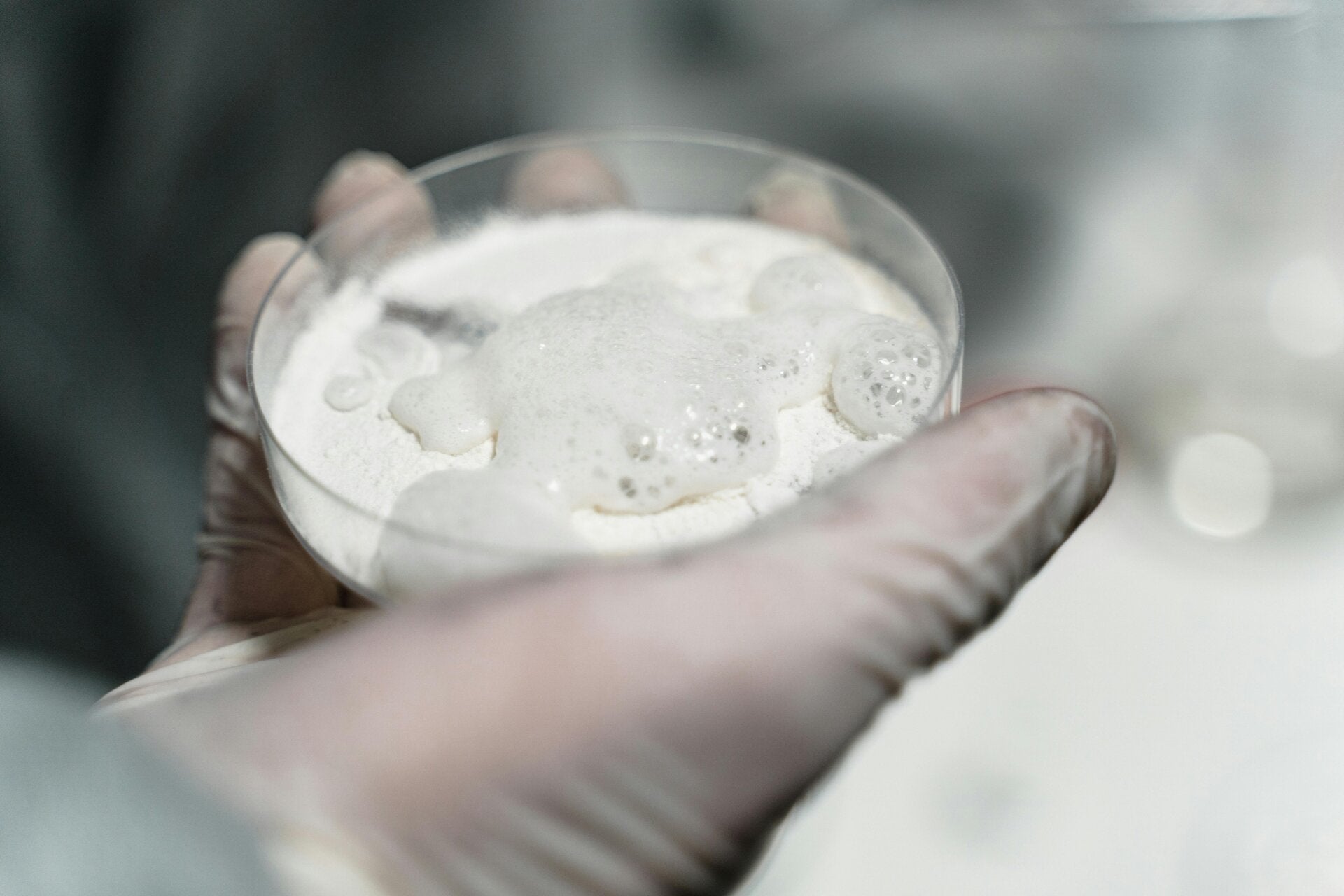
Material Transformation
Date palm waste contains cellulose, a natural polymer made of long chains of glucose molecules. This cellulose acts as the main raw material for producing bioplastics.
The process begins by extracting cellulose from the date palm fibers using chemical treatments that remove impurities such as lignin and hemicellulose. Once purified, the cellulose is chemically modified or combined with plasticizers to form biopolymers. These biopolymers have properties similar to traditional plastics, such as flexibility and strength.
Plasticizers, such as glycerol, are added to improve the material’s flexibility and prevent it from becoming brittle. The chemical structure of the bioplastic allows it to maintain its shape during use but break down more easily when exposed to environmental conditions.
Chemical testing is also important to evaluate properties such as tensile strength, heat resistance, and biodegradability. These tests ensure that the material is strong enough for practical use while still being environmentally friendly.
Unlike conventional plastics made from petroleum, this bioplastic is based on renewable natural resources and can undergo chemical breakdown into simpler, non-toxic substances, making it safer for the environment.

Rate of Decomposition
The amount of plastic remaining over time can be represented by a function P(t), where t represents time.
Derivatives are used to measure the rate of decomposition. The expression dP/dt shows how quickly the plastic breaks down at any given moment. Since the amount of plastic decreases over time, this value is negative. By analyzing this rate, it is possible to understand how environmental conditions such as temperature and humidity affect decomposition.
In hot climates like the UAE, higher temperatures can increase the rate of reaction, making dP/dt more negative and causing the plastic to decompose faster. This is important when designing materials that are suitable for desert environments.
Integration is used to calculate the total amount of plastic decomposed over a given period of time. By evaluating the integral of the rate of decomposition, we can estimate how much material has broken down between two points in time.
Exponential decay model showing plastic decomposition over time
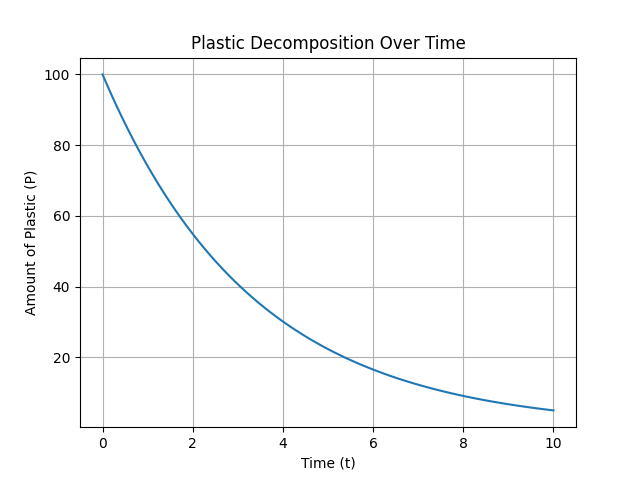
The graph shows how the amount of plastic decreases over time. At the beginning, the amount of plastic is at its highest, and as time passes, it gradually decreases.
The slope of the curve represents the rate of decomposition (dP/dt). Since the graph is decreasing, the slope is negative, which means the plastic is breaking down over time.
In hotter environments, such as the UAE, the curve becomes steeper. This means the rate of decomposition is faster because higher temperatures increase the speed of the reaction.
The area under the curve represents the total amount of plastic that has decomposed over a certain period of time. This is found using integration.
Create Your Own Website With Webador